
PASS Experimental Publication: A Spatial Iteration in an Ongoing Publication Proces
Cally Spooner - A Grandmother, Mike Kelley and Nature
Talk: 25 September 08.30 am
Join us for a morning talk between Associate Professor Nanna Bonde Tylstrup and Cally Spooner on trace, at the beginning of their respective new research projects. Both projects share a commonality in thinking through and with shards and residues — across cosmos, archives, embodiment, data loss, and deep time — and in developing a lexicon that might move beyond entanglement.
In 14.2.67A (Building 14, 2 floor, room 67A)
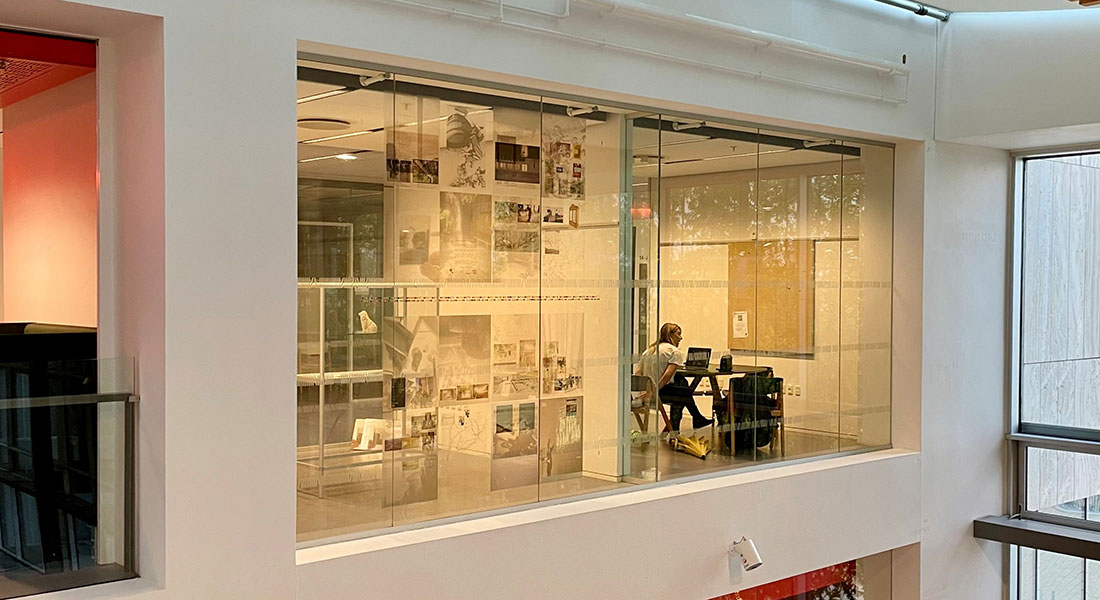
What might liveness be when it is not confined to performance? Where might it reside, and what kinds of relations might allow it to persist? What forms of intelligence does it contain? And what traces can it leave behind, which themselves remain as continual movement and unmaking?
These questions are at the centre of A Grandmother, Mike Kelley and Nature, Cally Spooner’s ongoing artistic and theoretical research into forms of somatic, minor intelligence, which she brings to PASS - Center for Practice-Based Art Studies at the University of Copenhagen. The project begins from an unlikely convergence: a southern Italian grandmother perpetually excavating her garden, US artist Mike Kelley performing live in 1981, and the threshold between northern and southern European, in the unstable region of the Ligurian Alps. From here, Spooner is developing a longer-term investigation into liveness as a form of restlessness - a refusal to settle - and a resistance to what has been described as both the ruins of neoliberalism and as end times fascism At the core of the research is an attention to the body, the psyche, the social and material fabric: to the ways in which they are entangled, porous and responsive, and to the complex, intersubjective practices that emerge through these relations. Questions of grief, falling, gravity, unmaking and irreconcilability enter into this investigation alongside a broader question: how might something remain alive precisely through its inability - or refusal - to settle into a fixed form?
It is this state of overgrown-process that Spooner has been invited to bring to PASS. Rather than a completed project, she brings to the centre a body of thinking and working that is still finding its relations in traces of fieldwork: 974 images, I.phone notes, watercolour sketches, quotations, scans, and other fragments, some of which touch directly on A Grandmother, Mike Kelley and Nature, while others emerge from practices and encounters that have become entangled with the research.
What happens when these materials are not simply presented, but placed into relation with other practices, other ways of knowing, and other ways of looking?
This question initiates PASS’s Experimental Publication process. Here, publication is not approached as the moment when research has been completed and is ready to be communicated. Instead, it becomes one of the conditions through which research can continue to take shape.
The first stage is Deep Publishing, an editorial and spatial practice developed by Benjamin Åbäke. During the session, Spooner’s materials are brought into a shared physical space. Images, texts, references and fragments are printed, moved, juxtaposed, edited and sequenced. A group of invited practitioners enters into this material, bringing their own practices and ways of thinking into proximity with it: poet and scholar Jackie Wang; psychiatrist and neuroscientist Isabel Vali; chef and curator at Kunsthaus Zürich Hendrik Folkerts; and director of Overgaden Rhea Dahl.
The point is not to arrive at a reading of the work, or to evaluate what is already there. It is to see what else might become possible and emerge when materials are placed next to one another, when a reference encounters an unexpected practice, when an image is moved, when a thought is interrupted or taken somewhere else. Deep Publishing is therefore both an editorial process and a form of collective enquiry.
In this sense, the workshop functions as a rehearsal for publication. Material is collectively edited, sequenced and designed into a 16 page publication, but this publication is not yet the destination. It is a temporary materialisation of the research - a way of seeing what the research might become when it is made spatial, shared and collectively edited.
The process then moves into a spatial iteration. Rather than turning the workshop into a conventional exhibition, the spatial iteration asks what happens when some of the propositions, questions and movements that have emerged through the Deep Publishing process are given another temporary form. The research is placed into a new set of relations: with space, with you as an audience, with voices and bodies beyond those present in the workshop.
The spatial iteration is therefore not a presentation of what has been found. It is another moment in which the research is put to work: another opportunity for it to encounter, to shift, to become otherwise.
What happens in the spatial iteration then feeds back into the ongoing editorial process. The Deep Publishing session, the spatial encounter and the public event Sept. 25th at 8.30 am become materials through which the research can be reconsidered and reorganised. From here, PASS, Åbake and Spooner return to the question of how the work might take printed form.
The printed publication that emerges from this process is consequently not conceived as a definitive endpoint. Rather, it is one particular materialisation of a research process that has already passed through different forms, encounters and modes of editing.
This is central to PASS Experimental Publication: to ask what publication might become when it is treated not simply as a vehicle for communicating knowledge, but as a practice through which knowledge is produced. A process that continues after the printed publication has taken form
The series works with research while it is still unfolding - attending to its fragments, hesitations, propositions, frictions and encounters. It asks what becomes possible when artistic and academic practices are brought into sustained dialogue, and when publication itself becomes a site in which different forms of knowledge can meet without necessarily being resolved into a single position.
The Novo Nordisk Center for Practice-Based Art Studies (PASS) at the University of Copenhagen is a research centre concerned with how knowledge is produced through artistic, curatorial and practice-based forms of enquiry. Its Experimental Publication series extends this concern into the practices of editing, publishing and making public.
Rather than asking only how can research be communicated?, the publication process asks a slightly different question: what kinds of research become possible and is created when publishing itself becomes part of the enquiry?
In this sense, A Grandmother, Mike Kelley and Nature is not simply being published by PASS. It is being thought, tested and transformed through publication.
The Experimental Publication series continues
Cally Spooner is the first practice invited by PASS to enter the experimental publication process. The series will continue to unfold twice a year through other practices and projects, each entering the process at a particular moment in their ongoing research
This year, the process continues with Simian, an artist-run exhibition space, run by artists Markus von Platen, Christian Vindelev, Jan S. Hansen and Toke Flyvholm. From 6-8 October 2026, Simian’s spatial iteration will unfold in this space, following Cally Spooner’s spatial iteration 24-25 September 2026. As you encounter this text within the space, the two iterations form part of a continuing sequence: different practices entering into the PASS Experimental Publication process, each bringing their own ongoing research into relation with the space and its publics.
Next year, two other practices will be invited to engage with PASS Experimental Publication, each bringing an ongoing project into this process of collective editing, spatial thinking and publication.
The series will continue to develop through these encounters, allowing each invited practice to shape and, in turn, be shaped by the publication process.
To follow the ongoing work of PASS Experimental Publication and other activities at PASS, you can sign up for the PASS newsletter through the PASS website and follow PASS on social media.
Map of South Campus
View directions.
View on map of the Faculty of Humanities - South Campus.
View map of South Campus (pdf).