
Critical Environments: PASS Intensive Residency
This course supports practice-based researchers, including PhD students, museum and archive professionals, artists, and others across all areas and disciplines of Art Studies, by deepening and strengthening their research methods and practices and their understanding of the field's emergent and hybrid spheres of activity.
The forces of the Earth seem to have permeated the socio-political spheres in which so-called modern societies have operated so powerfully until recently. We are suddenly finding ourselves exposed with the fragility of the Earth and at the same time exposed to an intrusion of earthly forces we cannot control. This acute situation, which can be seen as a crisis of imagination, calls for altered sensibilities, revived rituals and other ways of instituting and archiving in this situation, which might not even constitute a polis in the way Euro-American politics understands it. This Intensive Residency invites participants to examine and share how art and other creative practices can respond to, e.g. climate change, biodiversity destruction, the effects of extractivism, and dramatically altered living conditions caused by what, among other things, has been named ‘The Intrusion of Gaia’.
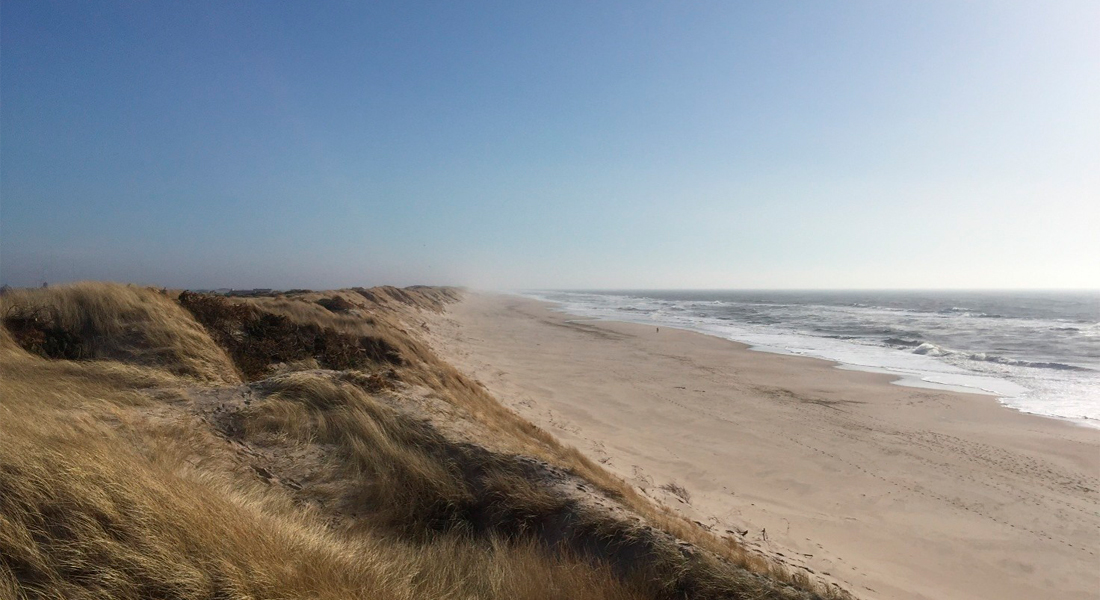
In support of the Earth being the actual protagonist of the course, the residency will take place on the west coast of Jutland in a landscape that bears a series of relevant historical features and exposes several of the current conflicts and tensions, which is the focal point of the course. An anthropogenic landscape that simply would not exist without 200 years of continuous human intervention through coastal engineering. Characterised today by intensive agriculture, extensive areas with solar panels, some of the world’s largest wind turbines and until ultimo 2026 large-scale production of agrochemicals, the area is continuously being shaped by several global actors and capital interests. The course will be actively situated in this landscape.
Knowledge-producing practices in the arts are multivalent, and applicants are therefore invited to present their research in a variety of forms, ranging, e.g. from academic presentation to performative approaches.
Target group
The course target group is practice-based researchers in the field of art studies.
This course will create a significant network and cohort of researchers and PhD students at the increasingly important intersection of different practices in art studies, supporting them to co-create its future methods, meanings and modes. Twelve participants will be selected to share their current research for feedback, and the residency format will allow for extensive informal exchanges for all.
Aims of the course
The wider field of Art Studies encompasses many practice-based researchers whose methods vary wildly and yet also intersect. Doctoral students and their peers in this field effect their research in universities, libraries, archives, museums, art studios and other practice-based contexts, deploying mixed and emergent methods often from a singular position and at times isolated from one another. This course aims to bring them together in purposive and valuable ways.
The PASS Intensive Residency offers practical research methods training delivered with hands-on pedagogical approaches including professional and peer-to-peer workshops. The programme distils PASS's practice-based activities into a five-day course with space for practice presentations and feedback. The residency is rooted in PASS's Research Platform and designed to support and articulate deep understandings of significant areas of study across our communities.
Skills acquisition in practice-based research methodologies and applied art studies knowledge production, developed in collaborations between academics, museum and archive professionals, artists, and other significant researchers.
Skills acquisition in identification of emergent methods; in recognising and supporting epistemic equity; and in interdisciplinary and inter-institutional collaborations.
Development of inclusive and exploratory critical thinking skills across widely divergent modes of practice and presentation skills for the expanded field of art studies.
Wider theoretical contextualisation of these methods in terms of bridge-building between academics, museum and archive researchers, artist researchers and others with a view to strengthening art's role and functions as a vital resource for a democratic society.
Application process
Application deadline: 23 November 2026
Notification: 14 December 2026
PASS courses are open to research colleagues across the Art Studies field, whether they are enrolled PhD students or hold other positions in the field.
Please write a motivation statement outlining your interests in the course and your reason for applying. This should cover your practice background and training, your relevant experience, and what you are seeking to gain from the course itself and from being part of this cohort. The statement should not be more than 500 words. Please submit a further page (an attached PDF with no more than 500 words and one image) outlining the contents of your proposed presentation and any additions to the reading list you might have. Your application is sent via email to pass@hum.ku.dk.
If you are a PhD student, the statement should state if you would like to receive ECTS credits from the course in relation to a PhD enrollment. Participation, including presentation, will give 4 ECTS.
The language of the course will be English.
The course will take place as a week-long intensive residency at Tuskær Center for Arts and Culture in the village Fjaltring by the North Sea. Originally a farm from 1864, Tuskær was transformed into an arts and cultural center in 1986. Together with the neighboring farm, which housed the Greenlandic Tuukkaq Theater, Tuskær has used its location by the North Sea as a force to both inform the arts and seek influence from worlds beyond the sea and known cultural spheres. Today, Tuskær also houses a respected vegetarian kitchen. Participants will be housed at Fjaltring Guesthouse and the former Rectory at Fjaltring Church.
Course participants will have their accommodation, hospitality and travel paid for by the PASS, and will be expected to participate fully in the intellectual and practice-based work of the course programme. Twelve participants will be selected to make presentations about their current work (in any relevant field) with a view to sharing methods, observations, and productive thinking. Social time and break-out sessions will enhance cohort creation. Required readings will be given, and ECTS points will be accorded to those researchers working at PhD level.
Participants are invited to submit pensum materials for the assembled cohort to read as part of the co-training aspect of the residency.
Sample readings include:
Dipesh Chakrabarty: “Anthropocene Time”, History and Theory 57, no. 1 (March 2018), 5-32
Emanuele Coccia: The Life of Plants – A Metaphysics of Mixture, Polity, 2019
Maja and Reuben Fowkes: Art and Climate Change, Thames and Hudson, 2022; chapters “Synthetic Environments”, “Expanses of Monoculture”, “Marine Permutations”.
Matthew Fuller and Eyal Weizman: Investigative Aesthetics, Verso (2021); chapters ”Aesthetics beyond Perception” and “How to inhabit the Hyper-Aesthetic Image”
Donna Haraway: Staying with the Trouble – Making Kin in the Chthulucene; chapters “Introduction” and “Tentacular Thinking”
Michael Kjær: ‘Field Aesthetics’
Jacob Lund: The Changing Constitution of the Present, Sternberg Press, 2022
Natalie Loveless: How to Make Art at the End of the World - A Manifesto for Research-Creation, Duke University Press, 2019; chapter “Art at the End of the World”
Thea Riofrancos: Extraction, W.W.Norton and Company, 2025; chapter: “Earthly Entanglements”
Susan Schuppli: Material Witness: Media, Forensics, Evidence, The MIT Press, 2020; “Opening Statements”
Isabelle Stengers: Another Science is Possible - A Manifesto for Slow Science, Polity Press 2018; Chapter “Cosmopolitics: Civilising Modern Practices”,
Sara Tolbert et. al. (eds.): Reimagining Science - Education in the Anthropocene, Volume 2, Palgrave Macmillan; chapter “In Conversation with Isabelle Stengers: Ontological Politics in Catastrophic Times”
Alberto Toscano: “The world is already without us”, Social Text 34 (2 (127)): 109–124, 2016
Anna Lowenhaupt Tsing; Heather Swanson; Elaine Gan; Nils Bubandt (eds.): Arts of living on a damaged planet - monsters of the anthropocene : ghosts of the anthropocene, University of Minnesota Press (2019); chapter “Bodies Tumbled into Bodies” M1-M12
Anna Lowenhaupt Tsing: The Mushroom at the End of the World - On the Possibility of Life in Capitalist Ruins, Princeton, 2015; chapter “Arts of Noticing”
Frederik Tygstrup: “Monstrous Landscapes” , forthcoming, 2026
Kathryn Yusoff: “Geotrauma, or Geology as a Praxis of Struggle”, Environmental Humanities 15:3 (November 2023)
Mikkel Bogh, Professor and Center Leader, Center for Practice-based Art Studies
Aske Viuff Jakobsen, PhD Fellow, Dept. of Arts and Cultural Studies, University of Copenhagen
Michael Kjær, Assistant Professor, Center for Practice-based Art Studies